


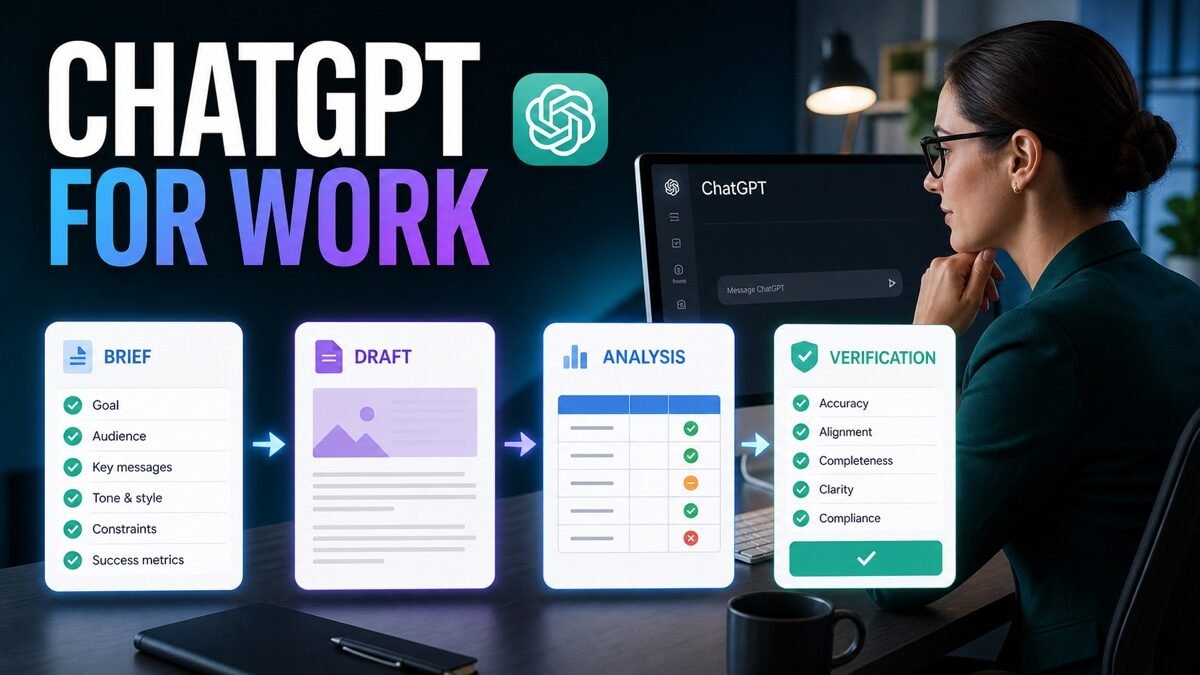
Choosing the right option for how to use ChatGPT for work is difficult for a simple reason: most pages compare feature lists, while buyers need to know what will happen inside a real workflow. This guide is for professionals, managers, marketers, analysts, operators, and founders. It explains the tradeoffs, gives you a controlled test, and shows which claims still need verification before money or sensitive data changes hands.
Quick verdict: Use ChatGPT as a structured drafting and analysis partner: provide context, define the output, require checks, and keep a human accountable for the final decision.
Research status: Facts and primary sources were reviewed on July 31, 2026. Prices, plan names, limits, and AI capabilities can change. Confirm volatile details on the provider’s official website before publishing or purchasing. For how to use ChatGPT for work, document how ChatGPT handles task selection before moving forward.
The quick answer
Use ChatGPT as a structured drafting and analysis partner: provide context, define the output, require checks, and keep a human accountable for the final decision. That conclusion assumes the reader values task selection, prompt context, and verification. If a different requirement is non-negotiable, the winner can change.
Daily Jade rule: Buy or adopt for a recurring job you can describe and measure today – not for a future workflow implied by a polished demo.
Best-fit snapshot
| Option | Best for | Verify before buying |
|---|---|---|
| ChatGPT | Teams that prioritize task selection | Confirm the current plan limits before purchase. |
What to compare
The right method is repeatable, reviewable, and safe for the information involved. The workflow below keeps a person responsible for consequential output. In the how to use ChatGPT for work workflow, treat prompt context as evidence to verify, not a marketing assumption.
- Task Selection: test it with a representative task, document the result, and note which plan was used.
- Prompt Context: test it with a representative task, document the result, and note which plan was used.
- Verification: test it with a representative task, document the result, and note which plan was used.
- Privacy: test it with a representative task, document the result, and note which plan was used.
- Reusable Workflows: test it with a representative task, document the result, and note which plan was used.
- Measurement: test it with a representative task, document the result, and note which plan was used.
Before testing, write a one-page operating profile: number of users now and in twelve months, the systems that must connect, the information involved, expected monthly volume, required approvals, and the person who owns the outcome. This prevents a generic recommendation from overriding the realities of your organization. The practical how to use ChatGPT for work check is whether ChatGPT improves verification in repeatable work.
How we evaluated the options
Daily Jade uses a workflow-first framework. Every candidate receives the same representative input, instructions, output requirements, and time limit. We add one difficult case because recovery controls and hidden restrictions rarely appear in a vendor’s best demonstration. Keep this result in the how to use ChatGPT for work scorecard so the decision remains reviewable.
| Criterion | Score | Evidence required |
|---|---|---|
| Task Selection | 1-5 | Observation, screenshot, export, timing, or current primary-source link |
| Prompt Context | 1-5 | Observation, screenshot, export, timing, or current primary-source link |
| Verification | 1-5 | Observation, screenshot, export, timing, or current primary-source link |
| Privacy | 1-5 | Observation, screenshot, export, timing, or current primary-source link |
| Reusable Workflows | 1-5 | Observation, screenshot, export, timing, or current primary-source link |
| Measurement | 1-5 | Observation, screenshot, export, timing, or current primary-source link |
A score without evidence is decoration. Beside every number, record what happened, which plan was tested, the date, and the source for any changing fact. Do not average away a deal-breaker. If a product lacks a required export, permission, integration, or control, remove it even when unrelated scores are high. For how to use ChatGPT for work, document how ChatGPT handles reusable workflows before moving forward.
What we did not assume
We did not treat popularity as proof of fit, a free plan as a permanent entitlement, an affiliate program as evidence of quality, or an AI-generated answer as a verified fact. A final published ranking should include hands-on notes from the actual product version. Where that evidence is not available, the article identifies a research shortlist and tells the reader how to test it. In the how to use ChatGPT for work workflow, treat measurement as evidence to verify, not a marketing assumption.
Step-by-step workflow
Step 1: Define the finished result
Write a one-sentence outcome for how to use ChatGPT for work. Include the audience, the action they should take, the source material available, and what would make the output unacceptable.
Step 2: Choose a low-risk test
Use ordinary, non-sensitive sample material. The first run should reveal whether the workflow supports task selection and prompt context without creating unnecessary risk.
Step 3: Set up the workspace
Create a repeatable folder, template, naming convention, and owner. Decide where source files, approvals, exports, and update notes will live before production begins. The practical how to use ChatGPT for work check is whether ChatGPT improves task selection in repeatable work.
Step 4: Create the first version
Complete the task end to end. Avoid polishing one isolated step. The useful question is whether the full path from input to finished result works for professionals, managers, marketers, analysts, operators, and founders.
Step 5: Review against evidence
Check facts, links, names, dates, permissions, and calculations. Ask a qualified person to review consequential material and keep a record of the source used for every volatile claim. Keep this result in the how to use ChatGPT for work scorecard so the decision remains reviewable.
Step 6: Refine one variable at a time
Change one element – such as verification – then compare the result. Controlled revision teaches the team more than changing the prompt, tool, format, and source material at once.
Step 7: Publish or send responsibly
Use the correct disclosure, consent, accessibility, and privacy controls. Preview the result on mobile, test every link, and make the next step obvious. For how to use ChatGPT for work, document how ChatGPT handles verification before moving forward.
Step 8: Measure and improve
Track a result connected to the job: time saved, completion rate, response quality, conversion, errors, or rework. Review the workflow after thirty days and keep only what delivers value. In the how to use ChatGPT for work workflow, treat privacy as evidence to verify, not a marketing assumption.
Buying and implementation guide
Calculate total cost at realistic scale
Model the cost when the workflow is established, not only during a trial. Include paid users, contacts, messages, credits, storage, premium connectors, administrator controls, implementation, training, support, taxes, and the renewal price. For usage pricing, calculate a normal month and a high month. For annual plans, identify the cancellation and refund terms before payment. The practical how to use ChatGPT for work check is whether ChatGPT improves reusable workflows in repeatable work.
Switching also has a cost. Data cleanup, migration, retraining, recreated automations, broken links, and temporary productivity loss can exceed a year of subscription savings. Export sample data during the trial and confirm that it is useful without the vendor. Portability is easier to protect before a tool becomes central. Keep this result in the how to use ChatGPT for work scorecard so the decision remains reviewable.
Review privacy, security, and governance
Identify what information enters the product, where it is stored, how long it remains, which subprocessors receive it, who can access it, and whether it may be used to improve a model or service. Review authentication, permissions, logs, deletion, export, incident communication, and data choices on the exact plan. Public marketing content and regulated customer information do not require the same controls. For how to use ChatGPT for work, document how ChatGPT handles task selection before moving forward.
Keep a human accountable for consequential work. Define who checks factual accuracy, legal or policy obligations, intellectual-property risk, brand fit, security exposure, and the final action. Automation should route uncertain or high-impact cases to review instead of publishing, sending, or updating a critical system without oversight. In the how to use ChatGPT for work workflow, treat prompt context as evidence to verify, not a marketing assumption.
Run a 30-day pilot
- Choose one recurring workflow and one accountable owner.
- Define a baseline for time, quality, cost, error, or conversion.
- Test typical work plus one difficult edge case.
- Collect friction, failed steps, and support experience.
- Compare the measured result with the complete cost.
- Keep, change, or cancel on the review date.
Adoption matters more than feature count. During the pilot, count duplicate entry, unclear ownership, private workarounds, broken automations, and tasks that still happen in spreadsheets or chat. Those signals often predict long-term value better than the demo. The practical how to use ChatGPT for work check is whether ChatGPT improves verification in repeatable work.
Affiliate placement suggestion
Place a clearly disclosed comparison CTA here only after the reader has seen the criteria and tradeoffs. Link to the provider’s current plan or trial page. Use rel="sponsored nofollow", and never allow commission to determine the ranking. Keep this result in the how to use ChatGPT for work scorecard so the decision remains reviewable.
Real-world example
Imagine a five-person team considering options for how to use ChatGPT for work. The buyer initially favors the product with the longest feature list. A controlled test reveals that the specialist option completes the weekly task twenty minutes faster, but its export requires cleanup and the required integration sits on a higher plan. The apparent winner changes once the team models twelve months of cost and the time needed to administer the workflow.
The team chooses a thirty-day pilot with non-sensitive data, defines a measurable target, and schedules the cancellation decision before the trial ends. That process does not guarantee a perfect choice. It does make the decision explainable, reversible, and less vulnerable to promotion-driven urgency. For how to use ChatGPT for work, document how ChatGPT handles reusable workflows before moving forward.
Expert tips
- Ask a vendor to demonstrate your workflow, not a prepared example.
- Confirm the exact plan required for every capability shown.
- Test failure: expired authorization, reached limit, missing owner, and unusable export.
- Separate verified facts, hands-on observations, and editorial recommendations.
- Date every price, plan limit, security claim, and product comparison.
- Keep the initial stack small enough that ownership remains clear.
Common mistakes
Choosing from a feature checklist alone
Feature parity says little about setup, reliability, permissions, revision, support, or the amount of cleanup required. Complete the same task in every finalist. In the how to use ChatGPT for work workflow, treat measurement as evidence to verify, not a marketing assumption.
Publishing unverified prices and limits
Commercial facts change quickly. Use primary sources, state the check date, and avoid precision when the provider does not publish it. If a claim was not verified, remove it or label the uncertainty. The practical how to use ChatGPT for work check is whether ChatGPT improves task selection in repeatable work.
Ignoring the exit path
A tool is easier to adopt than to leave. Test export, ownership transfer, link behavior, cancellation, and retention before importing valuable data or building multiple automations. Keep this result in the how to use ChatGPT for work scorecard so the decision remains reviewable.
Automating before the process is stable
Automation multiplies both useful work and bad assumptions. Standardize a narrow process, define exceptions, and keep human approval where errors could affect people, money, privacy, or public trust. For how to use ChatGPT for work, document how ChatGPT handles verification before moving forward.
Primary sources reviewed
External links are intentionally limited to authoritative pages that support changing or consequential claims. Readers should still verify the current plan, terms, and availability in their country. In the how to use ChatGPT for work workflow, treat privacy as evidence to verify, not a marketing assumption.
Related Daily Jade guides
Editorial verification worksheet
Before publishing this how to use ChatGPT for work guide, the editor should complete a dated worksheet for every recommendation. Record the tested account type, device, region, plan, input, output, time required, failures, support contact, export result, and source URLs. Readers should be able to understand which parts are verified facts, which are observations from a defined test, and which are editorial judgments.
Recheck every statement involving price, availability, free limits, security, compliance, integrations, AI model names, data use, or commercial rights. These details change independently. A current feature page does not prove the feature is available in the reader’s country, account, or purchased plan. When evidence conflicts, prefer the provider’s current documentation and describe the uncertainty. The practical how to use ChatGPT for work check is whether ChatGPT improves reusable workflows in repeatable work.
Finally, read the article as the intended user: professionals, managers, marketers, analysts, operators, and founders. Confirm that the first screen gives a direct answer, the comparison defines meaningful differences, the recommendation explains who should choose something else, and every CTA follows useful analysis. Remove repeated claims, unearned superlatives, vague statistics, and any sentence added only to reach a word count.
Frequently asked questions
How can I use ChatGPT in my job?
Start with task selection and prompt context. Use the same representative task, current official information, written success criteria, and dated evidence for every option. Keep this result in the how to use ChatGPT for work scorecard so the decision remains reviewable.
What should I not upload?
Do not upload confidential, customer, employee, regulated, or proprietary information until the product and plan are approved. Review retention, model-training choices, subprocessors, permissions, deletion, exports, and human oversight. For how to use ChatGPT for work, document how ChatGPT handles task selection before moving forward.
How do I improve its answers?
Start with task selection and prompt context. Use the same representative task, current official information, written success criteria, and dated evidence for every option. In the how to use ChatGPT for work workflow, treat prompt context as evidence to verify, not a marketing assumption.
Can ChatGPT analyze files?
Start with task selection and prompt context. Use the same representative task, current official information, written success criteria, and dated evidence for every option. The practical how to use ChatGPT for work check is whether ChatGPT improves verification in repeatable work.
How do teams measure value?
Measure outcomes tied to the job, such as time, completion, response, conversion, errors, or rework. Also track task selection and prompt context.
Final recommendation
Use ChatGPT as a structured drafting and analysis partner: provide context, define the output, require checks, and keep a human accountable for the final decision. Use that as a shortlist decision, not a substitute for testing. Confirm the product on the exact plan, protect the exit path, and publish a rating only after an editor can support it with dated evidence.
Next step: Select the three options that best match your non-negotiable criteria, run one complete task in each, and record the result in a simple scorecard before starting a paid commitment. Keep this result in the how to use ChatGPT for work scorecard so the decision remains reviewable.



Join the conversation
Share a useful perspective, question, or first-hand experience with other Daily Jade readers.