


Searching for GitHub Copilot alternatives usually produces long lists with little help deciding what fits. This guide takes a different approach: start with the workflow, identify the constraints, and compare a small shortlist using consistent evidence. It is designed for developers comparing privacy, model choice, and agent workflows.
Editorial note: Product capabilities and prices change frequently. Confirm plan limits, security terms, and current pricing on each provider’s official site before buying.
The quick answer
Test candidates on your actual repository before standardizing across a team. For this category, the most important jobs are completion, codebase search, terminal help, and automated changes. A strong choice should handle those jobs reliably, make the limits clear, and let you export your work if your needs change.
Our rule: Buy for the recurring workflow you can describe today, not a future workflow suggested by a feature page.
Products to include in your first research pass
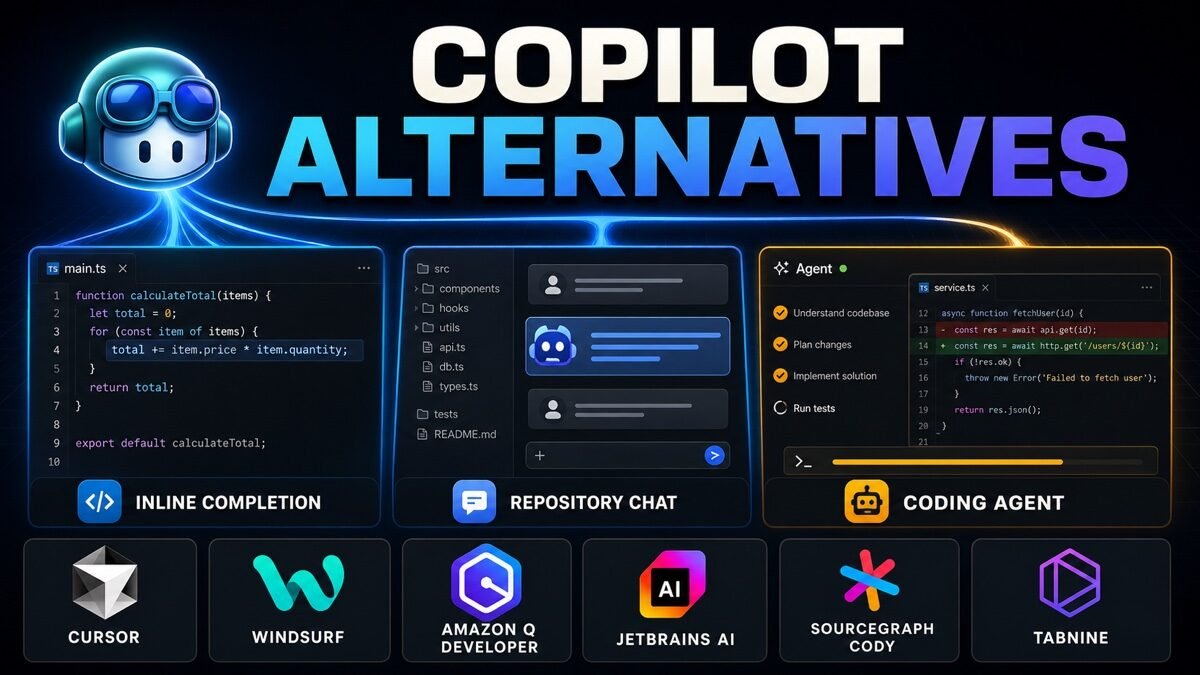
A sensible starting set is Cursor, Windsurf, Amazon Q Developer, JetBrains AI, Sourcegraph Cody, Tabnine. This is a research universe, not a fixed ranking: availability, plans, and capabilities change, and the right shortlist depends on your workflow. Verify each candidate on its official site, then narrow the set before testing.
How to choose GitHub Copilot alternatives
Write down one primary use case, one secondary use case, the number of users, the data involved, and your acceptable monthly cost. Then compare products using the same sample input. A controlled test exposes differences that feature checklists miss.
- Accuracy: test this against a real task, document the result, and note any plan-specific limit.
- Context: test this against a real task, document the result, and note any plan-specific limit.
- Privacy: test this against a real task, document the result, and note any plan-specific limit.
- Developer Experience: test this against a real task, document the result, and note any plan-specific limit.
Test before you commit
Use a free plan or trial with non-sensitive sample data. Check export options and renewal pricing before entering payment details.
A repeatable evaluation framework
| Criterion | Test | Evidence to keep |
|---|---|---|
| Accuracy | Run one representative workflow | Record time, quality, and friction |
| Context | Run one representative workflow | Record time, quality, and friction |
| Privacy | Run one representative workflow | Record time, quality, and friction |
| Developer Experience | Run one representative workflow | Record time, quality, and friction |
1. Start with output quality
Quality should be judged against your intended result, not a polished vendor demo. Use two typical examples and one difficult edge case. Note how much editing or cleanup is needed before the output is useful.
2. Measure workflow fit
Count the steps from input to finished result. Look for the integrations your team already uses, but do not assume an integration is deep enough-test the trigger, data mapping, permissions, and failure handling.
3. Calculate total cost
Include seats, usage credits, storage, premium integrations, support tiers, and likely renewal pricing. For usage-based products, estimate a low, expected, and high month. The cheapest entry plan is not always the lowest-cost option after limits.
4. Review risk and control
Check data retention, training policies, administrator controls, deletion and export processes, and any compliance needs relevant to your organization. Do not upload confidential or regulated data during a casual trial.
Good signs
- Clear plan limits
- Useful exports
- Fast setup for the core job
- Transparent support options
Watch for
- Unclear renewal pricing
- Critical features gated unexpectedly
- Weak data portability
- Demo quality that is hard to reproduce
How to build a three-product shortlist
Choose one category leader, one specialist product for your main use case, and one value option. Test all three in the same week. Score each criterion from one to five, add a short evidence note, and weight only the two criteria that genuinely affect success.
Do not average away a deal-breaker. A product with excellent features may still be the wrong choice if it lacks a required export, security control, or integration.
Match the product to your operating reality
A strong GitHub Copilot alternatives decision begins with context. The right answer for a solo operator can be wrong for a team that needs approvals, shared assets, administrator controls, or procurement documentation. Record the number of users today and twelve months from now, the systems that must connect, the type of information the product will process, and the person who will own the workflow. That short operating profile prevents an attractive demo from becoming an expensive subscription nobody fully adopts.
For developers comparing privacy, model choice, and agent workflows, the most useful evaluation scenario is usually a complete task rather than an isolated feature. Test completion, codebase search, terminal help, and automated changes from beginning to end. Include setup, collaboration, correction, export, and reporting. A tool that produces an impressive first output may still add friction when users need to revise, approve, reuse, or measure the result. Record where manual work remains and decide whether that work is acceptable.
Build a defensible scorecard
A scorecard makes a buying decision easier to explain and revisit. Use a five-point scale, but require a written observation beside every score. Avoid giving every criterion equal weight. Select two requirements that determine success, two that materially improve the workflow, and several that are merely convenient. If a candidate fails a non-negotiable requirement, remove it instead of allowing unrelated strengths to hide the problem in an average score.
| Decision factor | Score | Evidence required |
|---|---|---|
| Accuracy | 1–5 | Link the observation to a real test, plan, or primary source. |
| Context | 1–5 | Link the observation to a real test, plan, or primary source. |
| Privacy | 1–5 | Link the observation to a real test, plan, or primary source. |
| Developer Experience | 1–5 | Link the observation to a real test, plan, or primary source. |
Keep the evidence compact: a link to the relevant plan page, a screenshot from the test account, the time needed to complete the sample task, an export file, or a note about the support response. This record is useful when pricing changes, a renewal approaches, or a stakeholder asks why the team selected one product over another.
Test the shortlist with the same inputs
Consistency matters. Give every candidate the same representative input, instructions, constraints, and success criteria. Use ordinary work rather than a specially prepared example that makes a product look good. Then add one edge case: a large file, an ambiguous request, a failed integration, a permission conflict, or an export that must be reused elsewhere. Edge cases reveal recovery controls and limitations that rarely appear in marketing material.
The initial research set may include Cursor, Windsurf, Amazon Q Developer, JetBrains AI, Sourcegraph Cody, Tabnine. Do not treat that list as a ranking. Confirm that each product is available in your market and supports the required workflow, then narrow the field. A category leader provides a useful baseline, a specialist can show what deeper workflow support looks like, and a value option tests whether the team needs the premium feature set at all.
Understand price beyond the monthly headline
Model cost at the point where the product becomes important. Include required seats, usage credits, storage, premium connectors, administrator features, implementation, training, and support. Check whether the published price assumes annual payment and what happens at renewal. For products priced by contacts, messages, transactions, minutes, or generated output, calculate a normal month and a high-usage month. A plan that looks inexpensive during a trial may become the most costly candidate after the workflow scales.
Also calculate switching cost. Data cleanup, migration, retraining, recreated automations, and temporary productivity loss can exceed a year of subscription savings. This does not mean a team should remain locked into a poor tool. It means portability and exit planning belong in the original purchase decision. Export sample records during the trial and confirm the files are usable without the vendor.
Review privacy, security, and governance
Before connecting real business data, identify what the tool receives, where it is stored, how long it is retained, who can access it, and whether it may be used to improve models or services. Review administrator controls, authentication options, audit information, deletion, export, subprocessors, and incident communication. Requirements differ by organization; a public-content workflow is not equivalent to handling customer, employee, financial, or regulated information.
For AI-enabled products, include human review in any consequential workflow. The interface can make an uncertain output look authoritative. Define who checks factual accuracy, brand or policy compliance, intellectual-property risk, security exposure, and the final action. Automation should route uncertain or high-impact cases to a person rather than silently publishing, sending, or updating a critical system.
Plan adoption before purchase
Software creates value when people use the intended workflow consistently. Choose a small pilot group, define one owner, document the minimum process, and decide what success looks like after thirty days. Useful measures may include completion time, error rate, adoption, response time, qualified opportunities, or fewer manual handoffs. Avoid vague targets such as “use more AI” or “improve productivity.” A measurable workflow gives the team a reason to keep, change, or cancel the tool.
During the pilot, collect user friction as well as output quality. Count logins, duplicate entry, unclear permissions, failed automations, and steps that still happen in spreadsheets or private messages. These observations often predict long-term adoption better than a feature matrix. If the product needs extensive workarounds during a controlled pilot, the burden usually grows after a broader rollout.
When a free plan is enough
A free plan can be a sensible choice when the workflow is low-risk, individual, easy to export, and below published limits. It is less suitable when the team needs dependable support, shared governance, service commitments, advanced security, or predictable capacity. Treat free access as an evaluation path-not proof that the product will remain free or continue offering the same limits. Revisit the upgrade path before the workflow becomes difficult to move.
Expert decision checklist
- Describe the recurring job and the person accountable for it.
- List non-negotiable integrations, controls, and export requirements.
- Test typical and difficult examples with the same inputs.
- Measure total cost at expected scale and at renewal.
- Review privacy, retention, permissions, and human oversight.
- Confirm support and recovery steps when the workflow fails.
- Run a time-limited pilot with a measurable success threshold.
- Document the decision and set a date to review it.
How to verify claims before buying
Use primary sources for facts that can change: the provider’s pricing and plan pages, documentation, security center, privacy terms, status history, release notes, and support policies. Third-party reviews are useful for discovering questions and recurring complaints, but they may describe an older version, another plan, or a sponsored relationship. Record the date beside any material claim so a future editor or buyer knows when it was checked.
Distinguish facts from observations and recommendations. “The plan includes an export” is a factual claim that needs a current source. “The export required cleanup in our sample workflow” is an observation that should identify test conditions. “Choose this option when portability matters” is a recommendation that must follow from the evidence. Keeping those layers separate makes content easier for readers-and AI search systems-to understand and cite accurately.
Do not invent precision. If a provider does not publish a limit, say that the limit was not found and ask support. If a test was not performed, do not imply hands-on experience. If products change before publication, update the evidence rather than preserving a convenient conclusion. Trust grows from useful uncertainty, clear sourcing, and corrections-not from sounding certain about every detail.
Questions to ask during a demo or trial
Ask the vendor to demonstrate your workflow with your constraints rather than repeating a standard presentation. Request the exact plan needed for every demonstrated capability. Ask which limits are enforced by seat, workspace, contact, record, credit, storage, automation run, or API request. Confirm whether onboarding, migration, templates, customer support, and required integrations cost extra. If the answer depends on a roadmap, evaluate the product that exists today.
Then test failure and exit paths. Ask what happens when a user reaches a limit, an integration loses authorization, a payment fails, an administrator leaves, or the team cancels. Confirm how long data remains available and which formats can be exported. A mature product experience includes understandable recovery, not only a smooth happy path. These questions also help distinguish a well-documented product from one that depends heavily on sales assistance.
Finally, ask for the security and privacy materials appropriate to your use case, including subprocessors and data-handling choices for AI features. The goal is not to collect documents nobody reads. It is to identify whether the product can meet the organization’s actual responsibilities before data and workflows become difficult to move.
Authoritative background resources
Related Daily Jade research
- Best AI Coding Assistants for Developers and Small Teams
- Best AI Writing Tools for 2026: A Use-Case Buyer’s Guide
- Best AI Image Generators for Marketing, Design, and Everyday Use
- Best AI Video Generators: Practical Picks for Ads, Training, and Social
Frequently asked questions
What is the best option for beginners?
The best beginner option has a short setup path, useful defaults, clear help, and an upgrade path that fits likely growth. Test the primary workflow before comparing advanced features.
Should I choose a free or paid plan?
Use a free plan for initial fit testing. Choose paid when the workflow is proven and the paid feature removes a measurable limit such as branding, capacity, collaboration, or automation.
How often should this decision be reviewed?
Review annually, before a major renewal, or when team size and workflow requirements change. Avoid switching for small feature differences unless the migration cost is justified.
Bottom line
The right GitHub Copilot alternatives choice is the product that performs your recurring workflow reliably, stays within a realistic total budget, and preserves appropriate control over data and exports. Build a small shortlist, test with consistent inputs, and keep written evidence for the final decision.


Join the conversation
Share a useful perspective, question, or first-hand experience with other Daily Jade readers.