


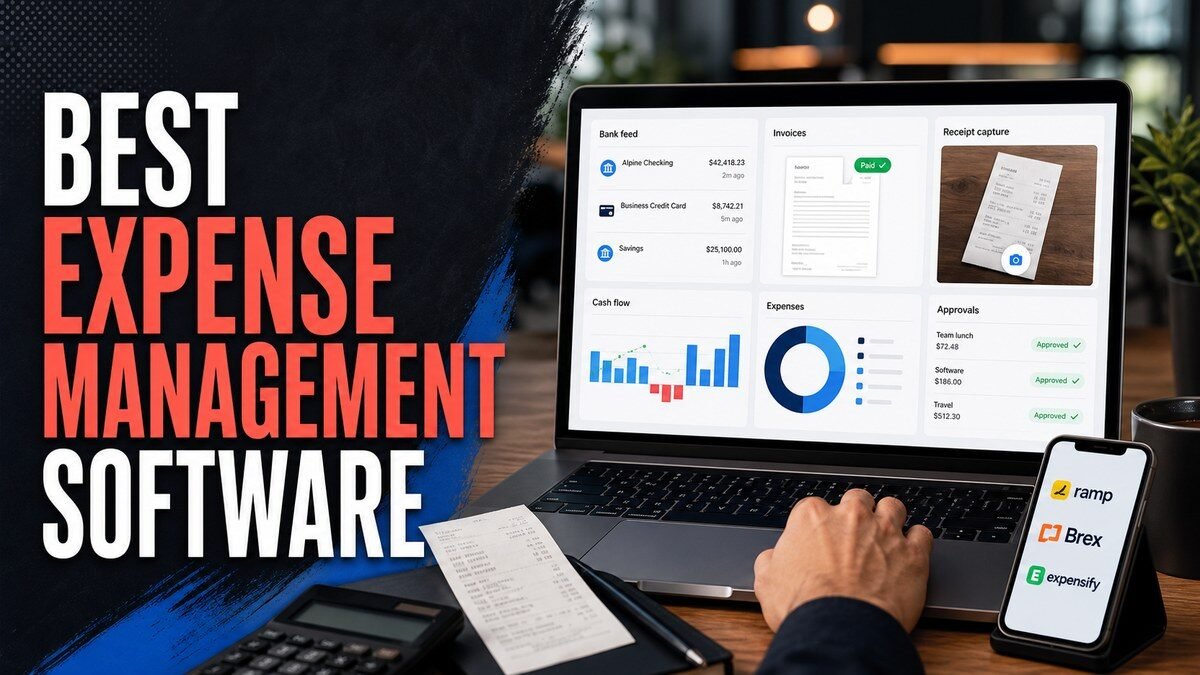
Choosing or implementing best expense management software looks simple until the team has to connect real data, people, approvals, systems, and deadlines. Feature lists rarely explain that operational reality. This guide is written for finance teams, startups, professional services, and growing businesses. It uses current official product sources, a transparent evaluation framework, and practical tests instead of invented usage claims.
Research status: Official sources listed below were reviewed on August 1, 2026. Product names, features, prices, limits, availability, integrations, and terms can change. Confirm volatile details on the provider’s current website before purchasing or publishing a consequential claim.
Quick answer
There is no universal winner. Start with Ramp as a category benchmark, then compare it with Brex and one specialist option using the same real task. Assess cards, receipts, policy controls, approvals, reimbursements, accounting sync, international use, analytics, support, and implementation.
Daily Jade rule: Adopt a tool or process for a recurring job you can describe and measure today. Do not buy for a future workflow implied by a polished demonstration.
Key takeaways
- Write requirements and deal-breakers before comparing Ramp, Brex, Expensify, and SAP Concur.
- Test the same representative task and one difficult edge case.
- Confirm the exact plan, region, usage, integrations, and commercial terms.
- Keep a human accountable for verification and consequential decisions.
- Calculate total ownership cost and test the exit path before commitment.
Who this guide is for
This guide serves finance teams, startups, professional services, and growing businesses. It is most useful when the reader has a real decision, rollout, or workflow to improve. If the organization handles regulated data, legal obligations, employment decisions, safety-critical work, or complex security requirements, involve qualified specialists before adoption.
Best options at a glance
| Option | Best for | Primary strength to test | Before buying |
|---|---|---|---|
| Ramp | Finance teams | Accounting Fit | Verify the current plan and run a full workflow. |
| Brex | Startups | Accuracy | Verify the current plan and run a full workflow. |
| Expensify | Professional services | Reporting | Verify the current plan and run a full workflow. |
| SAP Concur | And growing businesses | Collaboration | Verify the current plan and run a full workflow. |
| Zoho Expense | Finance teams | Migration | Verify the current plan and run a full workflow. |
| QuickBooks | Startups | Support | Verify the current plan and run a full workflow. |
Detailed recommendations
1. Ramp
Best for: finance teams who prioritize accounting fit.
Ramp represents a useful category approach for best expense management software. Put it on the shortlist only if its documented strength maps to work the team performs repeatedly. During evaluation, start with ordinary inputs, then add one edge case that exposes limits, permissions, collaboration, or recovery.
Record setup time, active work time, corrections, plan restrictions, support questions, export quality, and the final result. A familiar name or polished demonstration should not receive a higher score without evidence. Verify current availability, features, and commercial terms with the provider before purchase.
Reasons to shortlist
- Distinct fit around accounting fit
- Useful comparison benchmark
Reasons to pause
- May overlap with tools already owned
- Real cost depends on scale and plan
2. Brex
Best for: startups who prioritize accuracy.
Brex represents a useful category approach for best expense management software. Put it on the shortlist only if its documented strength maps to work the team performs repeatedly. During evaluation, start with ordinary inputs, then add one edge case that exposes limits, permissions, collaboration, or recovery.
Record setup time, active work time, corrections, plan restrictions, support questions, export quality, and the final result. A familiar name or polished demonstration should not receive a higher score without evidence. Verify current availability, features, and commercial terms with the provider before purchase.
Reasons to shortlist
- Distinct fit around accuracy
- Useful comparison benchmark
Reasons to pause
- May overlap with tools already owned
- Real cost depends on scale and plan
3. Expensify
Best for: professional services who prioritize reporting.
Expensify represents a useful category approach for best expense management software. Put it on the shortlist only if its documented strength maps to work the team performs repeatedly. During evaluation, start with ordinary inputs, then add one edge case that exposes limits, permissions, collaboration, or recovery.
Record setup time, active work time, corrections, plan restrictions, support questions, export quality, and the final result. A familiar name or polished demonstration should not receive a higher score without evidence. Verify current availability, features, and commercial terms with the provider before purchase.
Reasons to shortlist
- Distinct fit around reporting
- Useful comparison benchmark
Reasons to pause
- May overlap with tools already owned
- Real cost depends on scale and plan
4. SAP Concur
Best for: and growing businesses who prioritize collaboration.
SAP Concur represents a useful category approach for best expense management software. Put it on the shortlist only if its documented strength maps to work the team performs repeatedly. During evaluation, start with ordinary inputs, then add one edge case that exposes limits, permissions, collaboration, or recovery.
Record setup time, active work time, corrections, plan restrictions, support questions, export quality, and the final result. A familiar name or polished demonstration should not receive a higher score without evidence. Verify current availability, features, and commercial terms with the provider before purchase.
Reasons to shortlist
- Distinct fit around collaboration
- Useful comparison benchmark
Reasons to pause
- May overlap with tools already owned
- Real cost depends on scale and plan
5. Zoho Expense
Best for: finance teams who prioritize migration.
Zoho Expense represents a useful category approach for best expense management software. Put it on the shortlist only if its documented strength maps to work the team performs repeatedly. During evaluation, start with ordinary inputs, then add one edge case that exposes limits, permissions, collaboration, or recovery.
Record setup time, active work time, corrections, plan restrictions, support questions, export quality, and the final result. A familiar name or polished demonstration should not receive a higher score without evidence. Verify current availability, features, and commercial terms with the provider before purchase.
Reasons to shortlist
- Distinct fit around migration
- Useful comparison benchmark
Reasons to pause
- May overlap with tools already owned
- Real cost depends on scale and plan
6. QuickBooks
Best for: startups who prioritize support.
QuickBooks represents a useful category approach for best expense management software. Put it on the shortlist only if its documented strength maps to work the team performs repeatedly. During evaluation, start with ordinary inputs, then add one edge case that exposes limits, permissions, collaboration, or recovery.
Record setup time, active work time, corrections, plan restrictions, support questions, export quality, and the final result. A familiar name or polished demonstration should not receive a higher score without evidence. Verify current availability, features, and commercial terms with the provider before purchase.
Reasons to shortlist
- Distinct fit around support
- Useful comparison benchmark
Reasons to pause
- May overlap with tools already owned
- Real cost depends on scale and plan
Evaluation framework
Assess cards, receipts, policy controls, approvals, reimbursements, accounting sync, international use, analytics, support, and implementation. Turn that editorial position into evidence by scoring the same workflow against the same criteria. Write requirements before opening a pricing page so a persuasive demo cannot redefine the problem.
| Criterion | Score | Evidence required |
|---|---|---|
| Accounting Fit | 1-5 | Complete one representative task and record the time, errors, and revision needed. |
| Accuracy | 1-5 | Confirm the exact plan, region, account type, and current official documentation. |
| Reporting | 1-5 | Test a difficult case, an export, and the recovery path rather than only the happy path. |
| Collaboration | 1-5 | Identify who owns the setting, approval, review, and result after launch. |
| Migration | 1-5 | Calculate twelve-month cost at realistic users, contacts, usage, storage, and support. |
| Support | 1-5 | Document a pass condition and a deal-breaker before comparing products. |
Do not hide a deal-breaker inside an average. Missing export, required security control, regional availability, accessibility support, or a critical integration can remove an option even when unrelated scores are strong. Record the reason so the decision remains reviewable.
Pricing and total cost
Model twelve-month cost at realistic scale. Include users, contacts, messages, credits, storage, integrations, premium controls, implementation, data cleanup, training, support, taxes, and renewal.
Switching cost matters too. A lower subscription can be more expensive when migration, recreated automation, lost history, retraining, broken links, and temporary productivity are included. Test the export before valuable data enters the system.
Privacy, security, and responsible use
Identify what data enters the workflow, where it is stored, who can access it, which subprocessors receive it, how long it remains, and whether it may be used to improve a model or service. Check authentication, permissions, logs, deletion, export, incident communication, and plan-specific controls.
Keep a human accountable for decisions affecting people, money, privacy, security, employment, or public claims. Automation should route uncertain and high-impact cases to review instead of publishing, sending, or changing a critical record without approval.
Implementation plan
- Choose one recurring workflow and one accountable owner.
- Define a baseline for time, quality, cost, error, or conversion.
- Prepare ordinary, approved sample inputs.
- Complete a normal case and one difficult edge case.
- Verify integrations, permissions, exports, and recovery.
- Train a limited pilot group and document support questions.
- Review results after thirty days and keep, change, or stop.
Adoption matters more than feature count. During the pilot, count duplicate entry, unclear ownership, manual workarounds, broken connections, notification overload, and work that continues outside the system. Those signals often predict long-term value better than a polished demonstration.
Expert tips
- Ask a vendor to demonstrate your workflow, not a prepared example.
- Confirm the exact plan required for every capability shown.
- Date every price, limit, security claim, and product comparison.
- Test failure, recovery, ownership transfer, export, and cancellation.
- Separate verified facts, observed results, and editorial judgments.
- Keep the first rollout small enough that ownership stays clear.
Common mistakes
Choosing from a feature checklist alone
Features say little about setup, reliability, permissions, revision, support, or cleanup. Complete the same real task in every finalist and record the result.
Publishing changing facts without a date
Plans, prices, integrations, and AI capabilities change. Use primary sources, state when information was checked, and remove precision that the provider does not support.
Ignoring the exit path
Tools are easier to adopt than to leave. Test useful export, ownership transfer, link behavior, cancellation, retention, and recovery before the product becomes central.
Automating an unstable process
Automation multiplies both useful work and bad assumptions. Stabilize the process, define exceptions, and keep review where mistakes could create meaningful harm.
Key decision questions
- Does the workflow measurably improve accounting fit?
- Who owns accuracy after launch?
- What happens when reporting fails?
- Which plan is required for collaboration?
- Can the team export useful data and leave without unreasonable friction?
- What evidence will justify renewal?
Real-world scenario
A growing team evaluates best expense management software after a manual process becomes slow and difficult to review. The first favorite has the longest feature list. A controlled pilot shows that another approach requires fewer corrections, creates clearer ownership, and produces a more useful export. The apparent winner changes when the team includes administration, training, and renewal in the cost.
The team limits the pilot to approved sample data, records dated evidence, and schedules a decision before the trial renews. It does not assume the new workflow is permanent. The implementation includes a rollback path, a support owner, and a thirty-day review. This makes the decision explainable and reversible even if the product changes.
Primary sources reviewed
External sources are intentionally limited to official and authoritative pages. They support product identity and current documentation, but readers should still verify the exact plan, region, account, and publication date.
Related Daily Jade guides
- Perplexity Review: Is It Worth Using for Research?
- How to Use Claude for Work
- ChatGPT vs Perplexity
- Claude for Business: A Practical Guide
- Lifetime Software Deals
- Black Friday Software Deals
Frequently asked questions
What is the best way to start with best expense management software?
There is no universal winner. Start with Ramp as a category benchmark, then compare it with Brex and one specialist option using the same real task. Assess cards, receipts, policy controls, approvals, reimbursements, accounting sync, international use, analytics, support, and implementation.
What should be verified before launch?
Verify facts, names, dates, links, calculations, permissions, data handling, accessibility, current product terms, ownership, and the exit path.
How can a small team keep the process simple?
Choose one recurring workflow, one owner, one source of truth, one success measure, and a scheduled review. Add complexity only when evidence shows a real need.
How often should the workflow be reviewed?
Review after the initial pilot, before a major renewal, and whenever requirements, team size, product terms, or risk materially change.
What is a useful success metric?
Use a metric tied to the job: completion time, error rate, rework, response quality, adoption, conversion, support volume, or cost per successful outcome.
Final recommendation
There is no universal winner. Start with Ramp as a category benchmark, then compare it with Brex and one specialist option using the same real task. Assess cards, receipts, policy controls, approvals, reimbursements, accounting sync, international use, analytics, support, and implementation. Use that conclusion to create a shortlist or first implementation step, not as a substitute for current verification. Record the plan, date, evidence, limitations, and owner behind the final decision.
Next step: Choose one representative task, define pass conditions and deal-breakers, then complete the same test across the most relevant options before starting a paid commitment or wider rollout.


Join the conversation
Share a useful perspective, question, or first-hand experience with other Daily Jade readers.